a fact recently caught my attention. More than 300 million users of online social networks more widespread in our globalized world; only 5% declare themselves Catholic, that is made public as part of the profile characteristics of the category "religion" by choosing the "Christian Catholic."
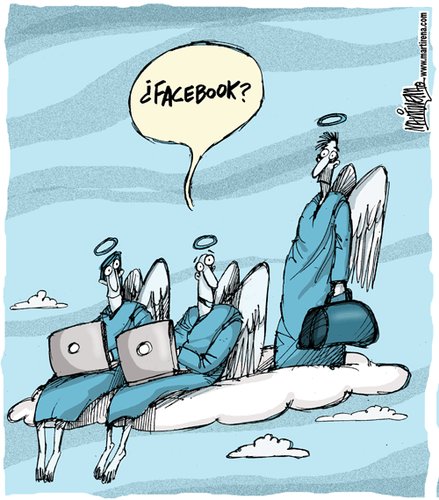 This curiosity came to discover in the Old Hall of the Vatican Synod - important ancient hall meetings - which were presented and discussed the latest developments in digital communication based on the internet during the meeting bringing together members and officials of the Media Council of European Bishops' Conference (CCEE).
 was the same "head of busness Development, Facebook Intenational" , or rather the head of the synergies and international agreements, Christian Hernández Gallardo - which until last October, Google works for -, which gave the data to the assembly while trying to explain how the aggregation sites and social interaction have abandoned the physical space to virtual reality privilege, especially in the net gneración or digital natives (the adolscentes today.)
back to 5% of Catholics virtual facebook, can make some considerations especially when such information is shown under the dome of St. Peter in an attempt to reconcile the Church (understood as the Mystical Body of Christ and not just as ecclesiastical hierarchy) and its relation to the new technologies.
While data is indicative only, it does not take into account people that being Catholic does not give importance to identify their religion on a social networking site, you can identify this small fraction of users as a universe youth integrated as part of its "virtual personality" religious space, we could say that this is a mass of Internet users which would be willing to share their religious experience in the world of social networking through new languages \u200b\u200band new forms of communication. INTER DIÁOLOGO

CATHOLIC?
in facebook or other social networking site a single individual becomes an activist with a click, or discarded friendships with one mouse-click. Had a look of Christian experience ended with a personal opinion, because even notice a lukewarm Catholic social networks. Several initiatives
Catholic Christian resemble a virtual space where the profiles or small groups of good will launch a real message without a feedback loop so that the interaction is very minimal. The usefulness of these social networks can be measured objectively in number visits, duration of contacts, messages cantindad return ... is still in an apparently superficial but is intended to deepen in interpersonal relationships where the profile or "avatar" start to make a face and personality that reflects the person we are interacting with the other side of the computer.
share our faith or religious experience in the virtual world is possible. Internet social networks may be a good exercise to do, but take into account that in these networks the equation: more posts = more interaction "does not necessarily mean that we are communicating well. Don Ariel


0 comments:
Post a Comment