The "wiki" global directory of media in the Catholic Church www.intermirifica.net just published the list of Catholic media Catholic Church in Cuba. One can see that there are about 60 organizations engaged in social communication in this country where the Church has no radio stations or television .
The communicative view of the Cuban church that emerges from "the yellow pages of the communication Catholic "reflects the process and the evolution of the ways to proclaim the Good News so that it has resonance in the society through its 52 publications (printed and virtual), at least 6 affiliates and 2 producers, all with limited access to the Internet.
But what was this internal process of communication Church in Cuba?
 After several decades of silence specific steps were taken with the birth of the Christian Life published in 1967, its production went through the mimeograph and the role coal became popular in the decade of the 90 and then transformed into hundreds of small leaflets or newsletters for catechesis and the mission, parish and group publications (periodicals and time.) Thanks to these young people had many news bulletins of the Church of Jesus Christ for the first time.
 RIIAL Already in 1995, had implemented a digital network interdiocesan internal communication through the Apostolic Nuncio and the Episcopal Conference that, among other things, served to prepare the visit of John Paul to the island
After the pontiff's historic visit to the island in January 1998, was systematizing the bishops' access to channels provincial official radio single significant dates or important celebrations in the liturgical year (Christmas and Easter) and the occasional television broadcasts of speeches by bishops and relevant celebrations of the Church in Cuba and the world.
With the "Internet boom" in the world, in the late 90's, despite limited access l in the Island, some bulletins began to be published on the Web, and explains the telecommunications engineer, María López, head of the Media Commission of the Archdiocese of Santiago de Cuba and current coordinator of the Catholic Press Union (UCP-Cuba ) -: "the Diocese of Pinar del Rio and his magazine Vitral were pioneers in digital communication, very early realized that the Internet opened up public space, it was necessary to use it to spread the message of the Word of God, mission, first of all Christians and all the Church. Gradually, other relevant publications, made the leap: New Word, Space Lay, Bioethics ... them possible not only to extend virtually the readership, but opened the possibility of immediacy, and contact "personal" with their readers, opening the possibility of exchange and debate, certainly limited by the frequency of them in print. "
"Scanning: No smooth
The efforts of print publications to enter the digital age and has had great difficulty because of access to Internet. Mr. Sergio Lázaro Cabarrouy, responsible for RIIAL in Cuba evaluates the process of digitization of communication Church in Cuba said that "Internet access is still very limited, so it is also a great part of town is the Church. At the headquarters of the Episcopal Conference and the bishoprics Internet access is no larger than 64 Kbps, one of which is in direct line (DSL), the rest are by telephone. Some religious houses and parishes have their own telephone access because in them lies a priest or nun who comes from another country as a missionary. Cubans still can not access the Internet at home so little pastoral make systematic use of the network "
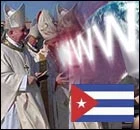 In this regard it should be remembered that it was the same President of the Pontifical Council for Communications, Archbishop Claudio Maria Celli , who during his last visit official Cuba in November 2009 stated publicly wish "that the Cuban church gradually may have normal access to mass media that the major technologies such as radio, television, Internet and multimedia, today we offer.''
 However, Sergio Lázaro Cabarrouy, who is also responsible for the blog creerencuba.org , clarifies that " However, from the Episcopal Conference, some dioceses, parishes and religious institutions have been founding and maintaining information services such as web sites and newsletters, which have hundreds and sometimes thousands of daily visits, 40% of which is made from within the island are few, but those few we are concerned, are the first steps to reach the many who hope to serve as access improves. For now responsible for RIIAL-Cuba used its access to the Internet to provide information to priests, religious and lay people who need it for their pastoral work, also keep forwarding news from various international agencies to our e-mail network that is supported by servers installed in dioceses and other institutions, who were long time connecting via phone and now do so through the only state Internet provider. RIIAL-Cuba also promotes the use of new information technologies in the life of parishes and provides training space for it. "
"Networking": the great challenge
Both the coordinator of the Catholic Union of the Press as responsible for the RIIAL-Cuba agree that Networking is really the great challenge, as is the certainty that "the work of our hands (publications, websites, information services ...) is not ours but God, all this means greatness of heart to see us reduce \u0026lt;>. I would say that we are learning to network, and that this is a moment in the life of the Church for it, "says Maria Lopez from Santiago de Cuba ."

Indeed, with online and print magazines, have been consolidating various experiences in the audiovisual field, the communication centers of the Salesian priests and Jesuits, as well as other dioceses who produce radio programs discrete and audiovisual quality, all this is distributed through cassettes and CD's from church groups and Catholic communities. Other forms of communication that have been consolidated are theatrical and musical groups, music festivals, almost artisanal and small publishers.
Thus, it in Cuba not only verifies the digital divide, but also a communication gap that pastoral agents try to settle. The solution not only happens for Internet access but also a complete change of mindset to be communication and networking, as experienced by a new generation of young Catholics born communicators need to be present in the world of youth using media and languages \u200b\u200bof its own, overcoming the impossibility of the paper printed a matter of costs publications and distributed only in digital format, publications that are high and yet, with a beauty and cleanliness of your presentation worthy of praise.
A concrete experience
 a renewed experience of network communication has been non-stop coverage of the pilgrimage the image of the Virgen de la Caridad del Cobre (the image of the Virgin Mambisa) for all Cuban diocese. Maria Lopez says: " we set that had a total coverage in the media that have to do so, Internet and e-mail from our nationwide network. The aim was to communicate the news that is not the place where she is the Virgin, or the number of those who attend meetings and events (although this is said) wanted to communicate the experience of faith of our people, the way of God through the image of the Virgin ... And it's really beautiful to be doers of the bridge.
 So we assembled a network of editors, photographers, computer, web master, communication officers, bishops, every one knew why, how and when to perform its functions so that information flow and bring the truth of which we are privileged to witness. "
_____________
Written by Ariel Beramendi
Thanks to: Maria Lopez and Sergio Lázaro Cabarrouy who helped writing this note.
Thanks to: Maria Lopez and Sergio Lázaro Cabarrouy who helped writing this note.

No comments:
Post a Comment